Otitis media is inflammation of the middle ear. Clinical signs include recurrent otitis externa, head shaking, pain with opening the mouth, Horner syndrome, dry eye, facial nerve palsy, decreased hearing, and head and neck pain. Otitis interna is inflammation of the inner ear. Clinical signs include ipsilateral head tilt, spontaneous horizontal or rotary nystagmus, and other clinical signs of peripheral vestibular disease. Diagnosis of each is based on clinical suspicion and supporting imaging (CT, MRI). Management should focus on treatment of infections (systemic and topical), decreasing inflammation, and treating any contributing factors.
Otitis media, inflammation of the middle ear structures (tympanic bulla, opening of the auditory tube, ear ossicles; see ), occurs in small and large domestic animals, including dogs, cats, rabbits, ruminants, horses, pigs, and camelids.
Otitis media can be unilateral or bilateral and can affect animals of all ages. Although typically sporadic, outbreaks are possible in herds.

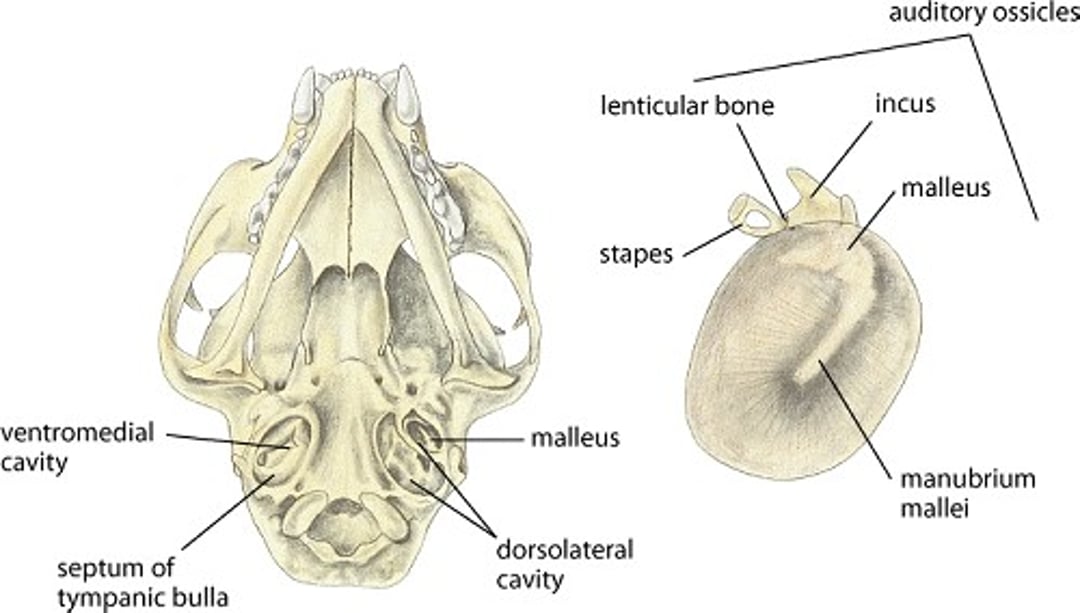
Left: Bony structures of tympanic bulla in the skull of a cat. Right: Tympanic membrane and auditory ossicles of a cat.
Illustration by Dr. Gheorghe Constantinescu.
Otitis media usually results from extension of infection from the external ear canal through the tympanic membrane or from migration of pharyngeal microorganisms through the auditory tube. Occasionally, infection extends from the inner ear to the middle ear, or it reaches the middle ear by the hematogenous route.
Primary secretory otitis media has been reported in certain breeds of dogs, particularly Cavalier King Charles Spaniels.
Untreated otitis media can lead to otitis interna (inflammation of the inner ear structures—the cochlea, vestibule, and semicircular canals) or to rupture of an intact tympanic membrane and subsequent otorrhea or otitis externa.
In dogs and cats, otitis media is less common than otitis externa, and otitis interna is rare.
Clinical Findings of Otitis Media and Interna
Clinical Findings of Otitis Media
Clinical findings of otitis media include the following:
Horner syndrome
facial nerve palsy/paralysis
keratoconjunctivitis sicca
impaired hearing
Clinical signs of otitis media frequently include those of otitis externa (head shaking, rubbing or scratching the infected ear, exudate in the ear canal). Other signs can include pain with opening the mouth and head or neck pain.
If the sympathetic nerves are affected, the patient may develop Horner syndrome (enophthalmos, ptosis, miosis). Keratoconjunctivitis sicca and facial nerve palsy are also possible, and exposure keratitis and corneal ulceration can also develop. With facial paralysis, the nasal philtrum or lip may deviate away from the affected side. Development of clinical signs such as Horner syndrome or facial nerve palsy help to distinguish otitis media from simple otitis externa.
Some animals may exhibit behaviors indicative of impaired hearing or deafness, which can be the result of fluid in the middle ear.
Otitis media does not cause a neurological head tilt; however, patients with ear pain may hold their head to the side.
In dogs, otitis media is often an extension of chronic otitis externa. Cases of chronic recurrent otitis externa, especially those that recur quickly after clinical and cytological resolution, may be due to untreated otitis media. More commonly, recurrence is because the underlying condition has not been controlled.
Primary otitis media can also occur, most commonly as primary secretory otitis media in Cavalier King Charles Spaniels.
Otitis media is less common in cats than in dogs; however, it does occur. Cats with otitis media frequently have a history of respiratory disease and/or inflammatory polyps. Less commonly, cats develop otitis media as an extension of otitis externa.
Otitis media can also occur in large animals, including ruminants, horses, pigs, and camelids.
Mycoplasma bovis is increasingly recognized as a cause of otitis media, respiratory disease, arthritis, mastitis, and other diseases in cattle. Otitis media associated with M bovis occurs in dairy and beef calves. Affected calves may be febrile and anorectic, develop ear droop or ear pain, exhibit head shaking, and develop other clinical signs of facial nerve paralysis. In calves, otitis media can be unilateral or bilateral.
Otitis media is uncommon in horses.
Temporohyoid osteoarthropathy (THO)—sometimes known as "middle ear disease" in horses—is characterized by a proliferation of the bone surrounding the temporohyoid joint and can lead to joint fusion and subsequent fractures. Extension of the fracture line to the calvaria can lead to intracranial spread of infection or cause hematoma and death. More commonly, the chief clinical signs are cranial nerve deficits (ptosis, ear droop, muzzle asymmetry, head tilt, and vestibular signs), resulting from inflammation in the guttural pouch around cranial nerves VII and VIII. Although inflammation and infection have been suggested as possible causes of THO, it is now believed to be primarily a degenerative condition and is not linked to otitis media.
Clinical Findings of Otitis Interna
Clinical findings of otitis interna include the following:
head tilt (see )
vestibular ataxia
spontaneous horizontal or rotary nystagmus


Left-sided head tilt in a young Boxer with otitis media and interna. Head tilt is a clinical sign of otitis interna; otitis media does not cause neurological head tilt.
Courtesy of Dr. Michelle Woodward.
With otitis interna, inflammation of the inner ear structures impairs function of the vestibulocochlear nerve (cranial nerve VIII), resulting in hearing loss and clinical signs of peripheral vestibular disease, such as the following:
ipsilateral head tilt
turning in tight circles toward the affected side
leaning or falling toward the affected side
general incoordination
spontaneous horizontal nystagmus with the fast phase away from the affected side
nausea
By itself, otitis interna does not cause altered mentation. Extension of infection from the inner ear to the brain leads to meningitis, meningoencephalitis, or abscesses, and clinical signs referable to those conditions.
Whereas animals with otitis media or interna are usually alert, nonfebrile, and have a good appetite, animals with meningitis or meningoencephalitis are usually lethargic, febrile, and have a decreased appetite.
A major differential diagnosis for otitis media and interna in ruminants is listeriosis. However, in listeriosis, cranial nerves other than VII and VIII may be affected, causing clinical signs such as dysphagia or loss of facial sensation, and affected animals are usually lethargic.
Diagnosis of Otitis Media and Interna
History and clinical examination
Otoscopic examination, if possible
Radiographic evaluation
CT or MRI for definitive diagnosis
Diagnosis of otitis media or interna begins with a complete history, a physical examination to identify applicable clinical signs, and, when possible, an otoscopic examination to confirm a bulging or otherwise abnormal tympanic membrane.
Otoscopic evaluation of the tympanic membrane may be limited by stenosis, ear canal anatomy, exudate, or animal-related or environmental limitations. Abnormal findings include a thick, opaque, ruptured, or bulging tympanic membrane, and the pars flaccida (located on the dorsal aspect of the membrane) may bulge because of increased pressure from air, fluid, or soft tissue. In some cases of otitis media, however, the tympanic membrane looks normal or intact, and bulging caused by air can also occur in healthy animals.
Video otoscopy helps to better visualize the tympanic membrane; however, viewing the middle ear is difficult without a small arthroscope. (See and .)

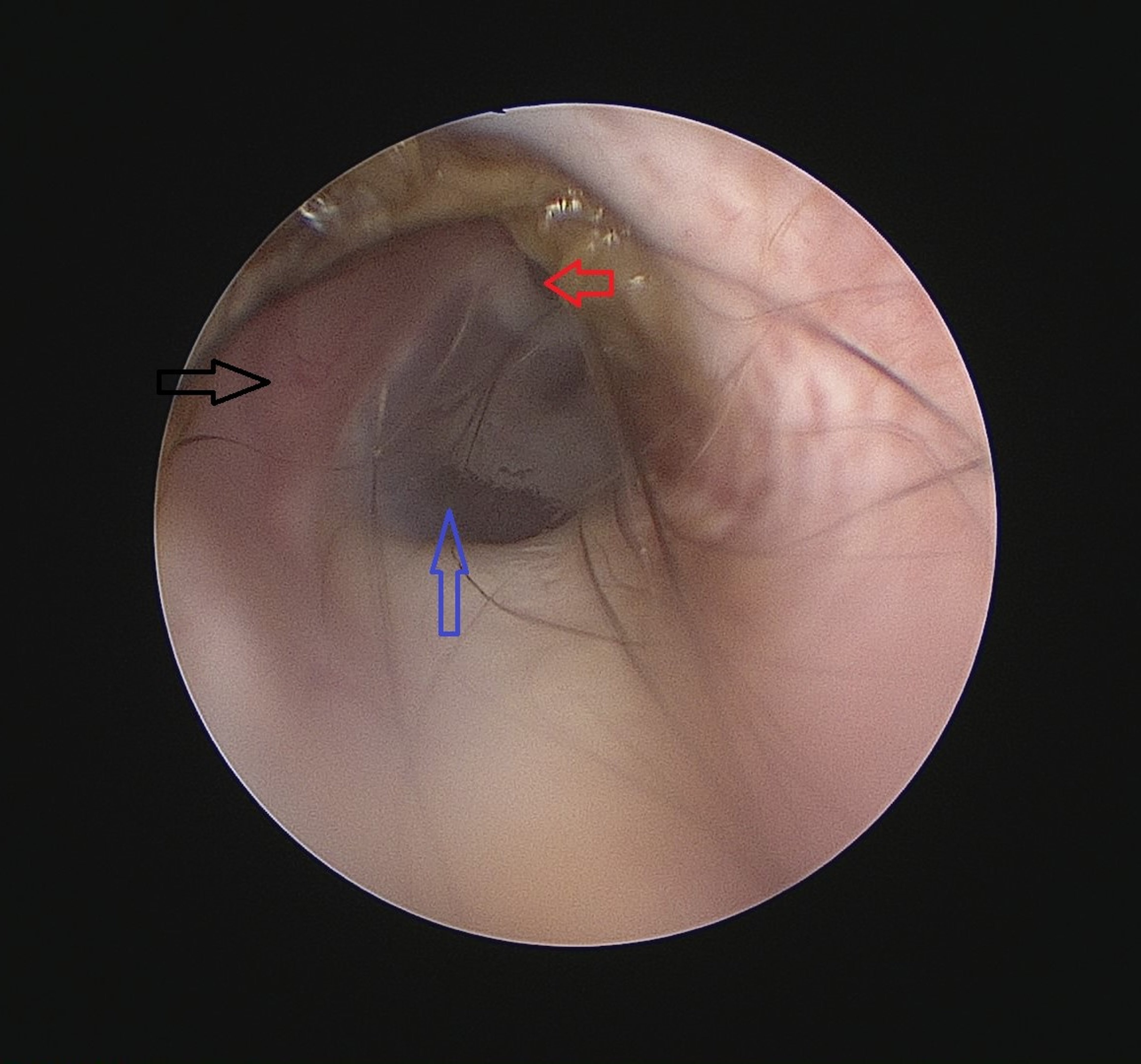
Otoscopic image of a normal tympanic membrane in a dog. Note the normal wax and hair in front of the tympanic membrane, as well as the healthy pars flaccida (black arrow), pars tensa (blue arrow), and manubrium of malleus (red arrow).
Courtesy of Dr. Sarah Hoff.

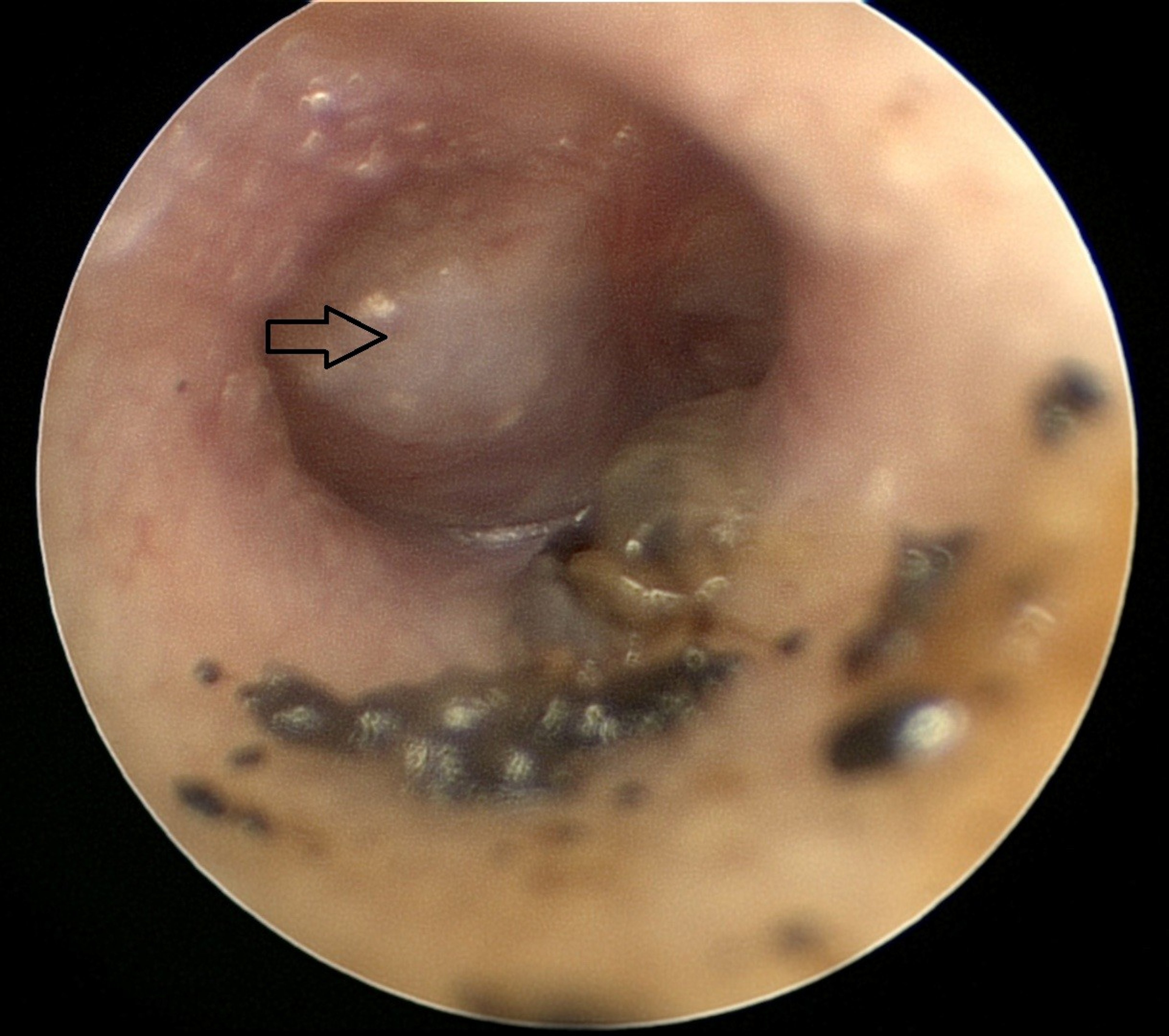
Otoscopic image of the tympanic membrane of a cat with otitis media. Note the bulging pars flaccida (arrow) and the opaque and discolored tympanic membrane, which appears whitish pink. Brown exudate is present on the ventral aspect of the horizontal canal.
Courtesy of Dr. Michelle Woodward.
In dogs, otitis media occurs most commonly in patients with chronic otitis externa (up to 80% of cases). Bilateral otitis media is not uncommon in dogs.
Primary and secondary causes and contributing factors of otitis externa can lead to otitis media.
Diagnosis of otitis media can be challenging, because the tympanic membrane can be intact and appear normal. Palpation of the tympanic membrane with a blunt instrument is not an accurate method of determining the patency of the membrane.
Advanced imaging techniques (CT or MRI) are more sensitive than routine radiography for definitive diagnosis of otitis media. However, fluid in the bullae has also been found in head CT scans of dogs with no history or clinical signs of otitis externa and media, so diagnosis may not be simple. Furthermore, advanced imaging cannot always reveal the integrity of the tympanic membrane. Changes visible in CT or MRI scans include thickening, sclerosis, and lysis of the wall of the tympanic bulla, and fluid or soft tissue material in the bulla itself. (See and .)


CT scan of the head of a Boston Terrier with otitis media and externa. The dog has right-sided otitis media with bulla osteitis (blue arrow) and bilateral otitis externa with nodules (red arrows) present in the ear canal.
Courtesy of Dr. Michelle Woodward.


CT scan of the head of a Cocker Spaniel with chronic otitis. The dog has severe chronic left otitis interna (blue arrow) and otitis media with bulla osteitis (red arrow) and bulla lysis (yellow arrow), and the severe chronic right otitis media with bulla osteitis (red arrow).
Courtesy of Dr. Sarah Hoff.
In large animals, presumptive diagnoses of otitis media and otitis interna are based on the patient's history and clinical signs. A history of any of the following, in conjunction with typical clinical signs of otitis media and interna, should prompt examination of the ear canal:
bottle feeding or feeding of contaminated milk (in neonates)
concurrent or previous respiratory disease
chronic ear infection
aural foreign body
In large animals, radiography can detect osseous changes in the tympanic bulla and fluid in the tympanic cavity if appropriate positioning and techniques are used (see ). However, CT and MRI are more sensitive and are the preferred methods when feasible.

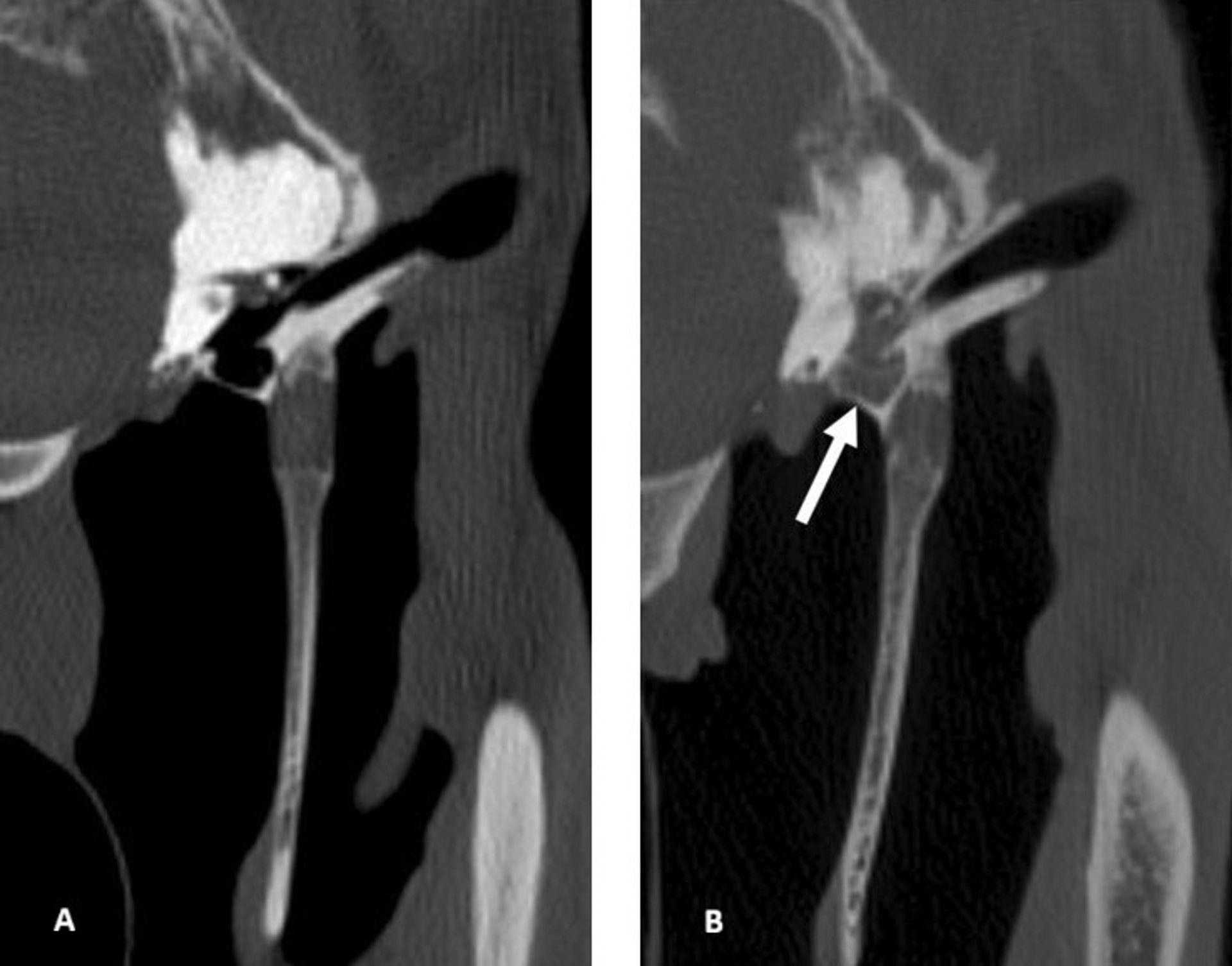
Transverse CT scans of the temporohyoid joint, tympanic bulla, horizontal ear canal, stylohyoid bone, and guttural pouch of a normal horse (A) and a horse with otitis media (B). A. Horse without otitis media: The horizontal ear canal, tympanic bulla, and guttural pouch are air-filled, and the stylohyoid bone and temporohyoid joint are of normal contour. B. Horse with otitis media: The tympanic bulla is filled with fluid (arrow). Helical acquisition, 120 kV and 400 mA, 512 × 512 matrix, 0.625 mm slice thickness, 0.3 mm slice interval, WW: 2800, WL: 800, bone kernel reconstruction.
Images from Dash RF, Perkins JD, Chang Y-M, Morgan RE. Computed tomography of the equine temporohyoid joint: association between imaging changes and potential risk factors. Equine Vet J. 2025. doi:10.1111/evj.14495. © 2025 The Author(s). Equine Veterinary Journal published by John Wiley & Sons Ltd on behalf of EVJ Ltd. Used under CC BY 4.0. Images extracted from Figure 1 (part A) and Figure 3 (part A).
In some cases, diagnosis of otitis media and interna is made only during necropsy, when special techniques are used to expose the tympanic region. Diagnosis of clinical otitis media and interna in one ear should prompt examination of the other ear to determine whether subclinical disease is present.
Pearls & Pitfalls
|
Treatment and Prognosis of Otitis Media and Interna
Video otoscopy and myringotomy, if tympanic membrane is intact
Middle ear flushing
Management of inflammation
Treatment of underlying conditions or infections
Treatment of otitis media and interna is most successful when started early in the disease course. In acute cases in dogs, special consideration should be given to evaluation for a foreign body (plant awn, foxtail) or iatrogenic rupture of the eardrum, possibly secondary to aggressive cleaning. Chronic cases are often refractory to treatment or recur after apparent remission.
Because dogs with otitis media often have a history of chronic or recurrent bacterial otitis externa, samples of exudate for cytological evaluation and bacterial culture should be taken from the middle ear, not the external ear. (Samples from the external ear are more likely to be contaminated.) To ensure the sample is taken from the middle ear, use of a handheld or video otoscope with a biopsy channel is preferred.
If the tympanic membrane is intact, myringotomy is commonly performed in dogs and can be done using one of the following: a sterile, rigid polypropylene catheter cut at a 60° angle; a long spinal needle; a curette; or even a carbon dioxide laser. The membrane should be punctured at the 5- to 7-o'clock (ventral) position to avoid the membrane's blood supply, which is more dorsal. Maintaining the blood vessels is important for healing and regrowth of the tympanic membrane.
Once the membrane is punctured, fluid and exudate can be removed aseptically from the middle ear with a catheter. The sample should be submitted for culture to aid in appropriate systemic antimicrobial selection.
After sample collection, the middle ear should be flushed copiously with sterile saline solution (0.9% NaCl).
The tympanic cavity in cats is divided by a septum, which can make treatment more challenging.
Because the eustachian tube connects the middle ear to the oral cavity, patients undergoing myringotomy should be intubated under general anesthesia, with the cranial aspect of the body tilted down to allow flow of fluid out of the mouth (to prevent aspiration). If general anesthesia is not possible, flushing can be done under heavy sedation; however, this is less safe.
Pearls & Pitfalls
|
Some patients may have worsening clinical signs acutely after flushing of the middle ear.
Many aerobic and anaerobic bacteria have been cultured from the ears of animals with otitis media or interna, and mixed infections are common. Bacteria that are frequently isolated include the following:
Pseudomonas spp and Staphylococcus spp in small animals
Mycoplasma bovis, Mannheimia haemolytica, Pasteurella multocida, and Histophilus somni in cattle
Streptococcus suis in pigs
Streptococcus spp in horses
Mycoplasma spp in goats
Which of these bacteria are pathogenic is unclear. Tympanic bullae often have oral microbiota (ie, because the bullae are connected to the oral cavity via the eustachian tubes).
Once specific pathogens are identified via culture and susceptibility testing, infections should be treated both topically and systemically when possible. Few products can be safely placed in the middle ear without risk of ototoxic effects. In general, the following medications are safe to use in the middle ear:
fluoroquinolones
penicillins
cephalosporins
miconazole
clotrimazole
nystatin
aqueous dexamethasone
fluocinolone
Thick, ointment-based medications should be avoided in the middle ear; tris-EDTA is safe to use for flushing.
No antimicrobial agents are labeled for treatment of otitis media or interna in food-producing animals in the US; therefore, guidelines for extralabel drug use must be followed, and prohibited drugs must be avoided.
In addition to administering antimicrobial and/or antifungal therapy, a veterinarian should clean and flush the external ear canal if otorrhea or otitis externa is present; saline solution (0.9% NaCl) and tris-EDTA are commonly used for flushing the external canal.
Topical and systemic steroids in some species can help decrease inflammation and pain associated with otitis media or interna and may improve other clinical signs.
Corneal ulceration, aural hematomas, and concurrent infections should be treated appropriately, if present, and the animal should be protected from further self-injury.
Infection with Pseudomonas spp can be particularly difficult to treat because of the presence of biofilm and the increasing resistance of Pseudomonas spp to antimicrobials. Silver sulfadiazine has been used in recurrent cases, as has N-acetylcysteine. Cases of otitis media or interna caused by Pseudomonas infection can be challenging and may not respond to aggressive, appropriate treatment.
Mycoplasma bovis infection is particularly problematic in dairy calves fed unpasteurized waste milk from cows with intramammary infection.
In chronic, nonresponsive, or recurrent cases of otitis media or interna, repeated flushing of the middle ear might be necessary. A bulla osteotomy may ultimately be needed to establish sufficient drainage and enable effective lavage.
Primary secretory otitis media in Cavalier King Charles Spaniels may improve after myringotomy and flushing; however, it can recur or require repeated flushing.
Early diagnosis and treatment of otitis media or interna can result in complete resolution of infection and clinical signs. However, in severe, chronic, or nonresponsive cases, owners should be advised that neurological deficits and hearing loss can persist, even if infection is resolved.
In dogs and cats, otitis media may require surgery (total ear canal ablation), particularly if multidrug-resistant bacteria are present.
Key Points
Otitis media and otitis interna are uncommon in animals.
In dogs, otitis media and otitis interna are usually the result of chronic otitis externa.
Diagnosis requires history, otoscopic and physical examination, and advanced imaging, if possible.
Treatment can be difficult and should be directed at treating infections and managing inflammation.
For More Information
Lorenz MD, Coates JR, Kent M. Handbook of Veterinary Neurology. 5th ed. Elsevier/Saunders; 2011.
Miller WH, Griffin CE, Campbell KL. Muller and Kirk’s Small Animal Dermatology. 7th ed. Elsevier/Saunders; 2013.
Gotthelf LN. Diagnosis and treatment of otitis media in dogs and cats. Vet Clin North Am Small Anim Pract. 2004;34(2):469-487.
Also see pet owner content regarding otitis media and interna in cats, dogs, and horses.